Showing posts with label turned weaves. Show all posts

Friday, September 25, 2015

Happy Towels

That first set of towels, hemmed and laundered.


The before- and after-wet-finishing is pretty dramatic with this structure.


Saturday, August 29, 2015

My Dance Card is Full

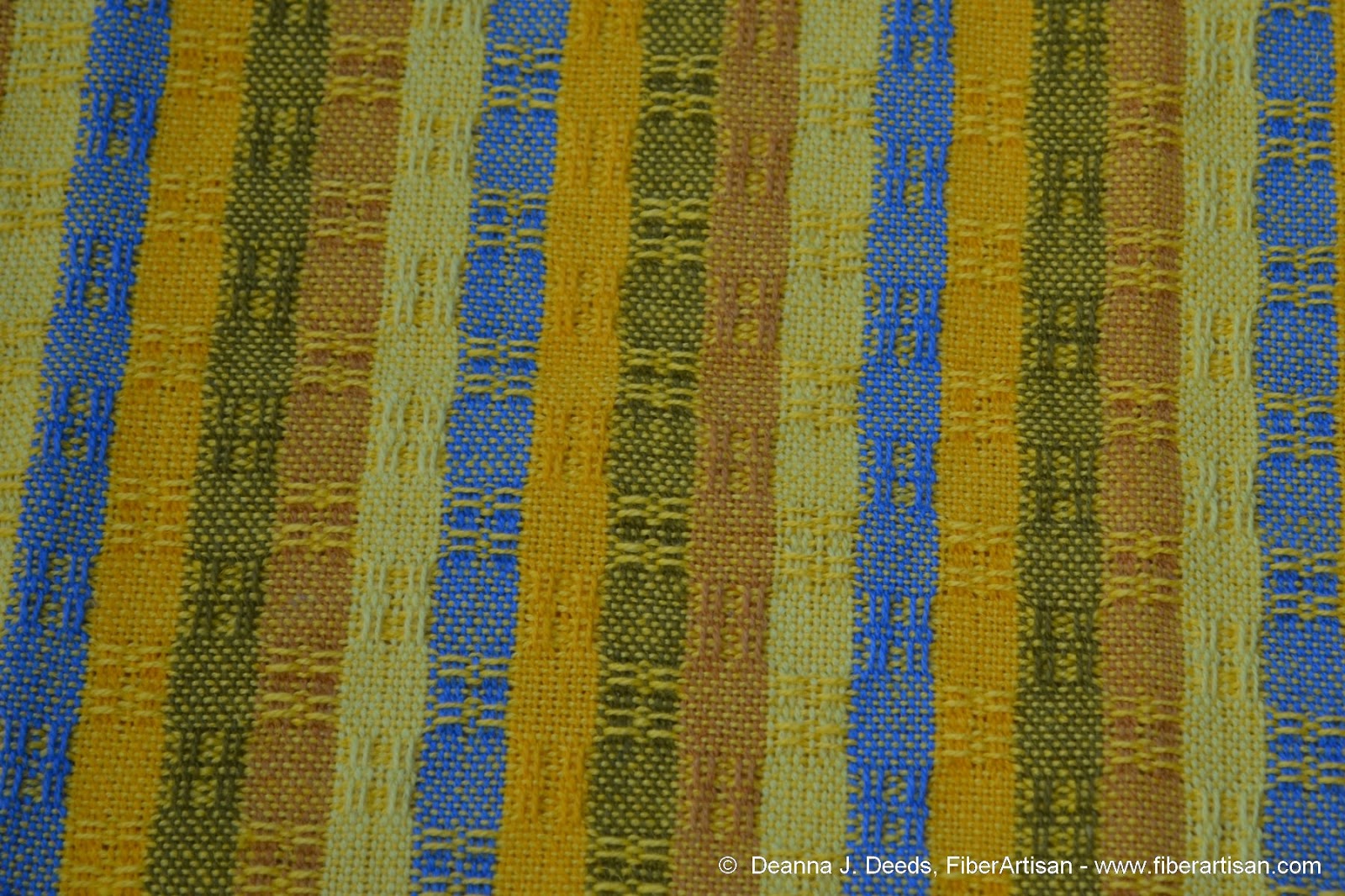
I finished the odd little 11-beat dance with this warp.  This one has a warm yellow weft.  I did two towels in each of four different weft colors on this warp.

I may do it again in a warp using another colorway, in between lots of other projects.

Saturday, August 22, 2015

Like Visiting an Old Familiar Friend

I was weaving this structure last summer, designing the towels that were in the Jan/Feb '15 issue of Handwoven.  I put it on the loom again this week, this time with lots of colors.  I had forgotten how fun it is to weave.  The last shot of each sequence becomes the first shot of the next, kind of like that old jump-rope rhyme where the last word of the verse sounds like it's going to be a naughty word, and it turns out to be the first syllable of an innocent one that starts the next verse.  You kind of lose a beat in the rhythm, which makes it hard to stop once you get going.

Tuesday, September 30, 2014

September's towel in autumn colors

September's towels are woven, hemmed, wet-finished and ready for service.

Unbleached 40/2 linen ground warp and weft, 22/2 cottolin supplementary pattern warp in fall colors.  Turned Monk's Belt.

Saturday, September 13, 2014

September weaving - Turned Monk's Belt

In weaving the turned monk's belt, I was having difficulty getting a nice shed to open because the warp is so dense.  The pattern warps also would sometimes sit on the "wrong" side of their companion ground warp which would put a spot of color in a position that I think doesn't look right.

 
I developed a sequence that helped me get through this problem.  Instead of using the tie-up as provided, I tied up the pattern shafts as a direct-tie, and the shafts that weave plain weave separately, plus a treadle to lift all the ground threads together.  So for each change of pattern block the weaving sequence is:

1. With the beater at the fell of the cloth, lift just the pattern shaft for the pattern you need to weave next.  (Opening a sticky shed with the beater at the fell gives the yarns the best chance of opening cleanly since there isn't the extra interference of trying to move through the reed.)

2. Push the beater back.  Clear the shed with a sword, bringing the pattern threads up to the fell so they sit up above the cloth and in between the proper ground threads.

3. With the top pattern threads still raised and the beater again at the fell, with the other foot raise both ground shafts.

4. Push the beater back and repeat the shed-clearing with the pattern threads that are on the reverse of the fabric, so they sit down below the cloth and between their proper ground threads.

5. Lowering the ground threads but leaving the top pattern threads still raised, weave however many picks are required according to the treadling pattern.

This is slow going, but I was such a happier weaver doing it this way!

Friday, September 5, 2014

A New Look for Atwater-Bronson Lace?

Can you believe this is the same structure as the May Towel of the Month?  Who knew Lace Bronson (aka Atwater-Bronson) could take on a three-dimensional look almost like a waffle?

To get this result, instead of threading 14 units of Bronson and one unit "turned" as in the May towel, I tried threading 2 units of the lace alternating with 2 units of the turned lace.  I wove similarly, 2 repeats of each treadling sequence alternately.

This is another sample, 2 units of lace threading alternating with 3 of the turned.  You can see that the fabric is not anything special to look at, under tension on the loom.
But what a surprise I had when I put the sample into water to wet finish them!  Had anyone walked into my kitchen they would have found me standing there grinning at the sink, almost bouncing up and down in delight.

The effect seems to be caused by the floats in the two directions all pulling the plain weave areas to one side of the fabric or the other when the yarns are allowed to relax in the water.

Monday, September 1, 2014

September's Towel - Turned Monk's Belt

The weave for the Towel of the Month for September is another "turned" structure: that is, it's woven with the patterning in the warp, whereas the "normal" way to weave it is with the pattern formed in the weft.  This design also has some color in it ("yay - finally!" say the color-lovers, after looking at all those natural-colored linen lace weaves).  The ground warp and the weft are unbleached linen, and I am using 22/2 cottolin as the colored pattern warp.

The draft looks a little complicated, but I've tried to add a few labels to fill in the blanks.  Start by looking at the center of the diagram, where there is a sketch of the width of the towel.  From right to left, there will be 74 ends of linen threaded on shafts 1 and 2 to weave plain weave, then a stripe of the pattern, then a central area of linen plain weave, another stripe, and finally 76 ends of plain weave.

The profile draft for the stripes is at the top of the diagram.  Each square represents a sequence of 4 threads, two linen and two pattern.  From right to left, thread two units of block A, then one of B and so on.  The threading for the two blocks A and B are at the left in the diagram.  When you are sleying the reed, the pattern stripes will be sleyed double the density of the plain weave portions: if you are using a 15-dent reed, all 4 threads go in one dent.

The colors of the cottolin are indicated at the bottom.  I wasn't sure what color "bittersweet" was, so I looked it up and it seems to be a salmony orange.  Notice that although the threading of the stripe is symmetrical, the color order is not, so reverse the order for the second stripe.   Since this is a supplementary warp, you may want to beam the cottolin separately from the linen if you have a second warp beam.


Saturday, May 31, 2014

May TotM Completed

The May towels are completed, and one will soon be on its way to its new kitchen-home.

Weaving this towel made me curious enough to try this structure (lace Bronson and turned lace Bronson) in another variant, and I got a surprising (to me) result.  More on that in a future post!

Saturday, May 17, 2014

May TotM - Weaving (Turned) Bronson Lace

Here's the May Towel-of-the-Month on the loom.  This is 40/2 linen warp and 20/1 linen weft, with stripes of 5/2 cotton warp and weft.

The "lace Bronson" (horizontal weft floats) and "turned lace Bronson" (vertical warp floats) are being used to put the thicker pink threads to the top side of the fabric, to accentuate the windowpane check.  I find it interesting that where the two lines of lace intersect, there is a little area of plain weave.

I omitted two picks before and after putting in the weft stripe, and I think it looks better this way.  Compare the intersection in the top of the photo with that at the bottom.  The one at the top is woven according to the original draft.  The one at the bottom omits the "extra" pick between the blocks in the treadling sequence, and omits one of the two picks on either side of that "extra" one.  So instead of adding a pick between the blocks, they are "sharing" a pick instead.  See how the plain weave area looks more square in the bottom intersection, while the top one looks like a vertical rectangle.

Here's the modified treadling sequence.  I think it must be the color-and-weave effect that makes me think this looks better, because now there is more plain weave in the horizontal direction.

Friday, May 2, 2014

May TotM - Turned Atwater-Bronson Lace


The May Towel of the Month features a lace weave.  It has warp floats in a contrasting warp, and corresponding contrasting floats in the weft direction, forming a windowpane-check-like design overall on the towel.

The lace is "turned", then, because some of the floats are weft floats (in the "default" or "normal" lace manner), and the other floats are "turned" - in the warp direction.

The draft in the Weaver's Journal article looks to me to have a couple errors in it.  I hope I've corrected them in the diagram here.  I tried it out in the weaving software I have and it looks right.  We'll see when we start the weaving on this one!

Since I haven't seen anyone new joining in here weaving along, I'm changing my plans and weaving only two of each towel, one to give to a family member and one to keep.  Otherwise I'll end up with 24 kitchen towels, which would probably last the rest of my life.  I still hope you will join in the fun and try some of these towels, and try weaving them in linen especially.  I am having fun weaving with linen, and the fiber is so thirsty it dries off dishes without spots or lint and is quick to dry hands as well.

Saturday, March 1, 2014

February TotM Finale

 
Here is  February's Towel of the month completed, wet-finished and ironed.  While weaving these, it occurred to me that maybe the switch from treadling A to B and back again at the hem ends was so that the fabric would match on the back when turned under for the hem.  So I did it both ways.  In the towel on the left, the hem matches on both sides; in the one on the right, it contrasts.

You can see the difference in the two yarns I used.  On the right is the heavier yarn I started with, and on the left the 10/2 that I swapped in after weaving the first towel.

I didn't see any comments that anyone was following in February, so I'm keeping both these towels for my kitchen.  The third towel went to another test kitchen, this time that of my sweetheart (it was, after all, Valentine's Day).

Saturday, February 22, 2014

February TotM update - trying a different supplentary warp

Since this is a supplementary warp, I didn't beam it with the linen.  In fact I didn't beam it at all; it's just weighted off the back of the loom, over the second back beam.  This keeps the cotton warp from hanging directly on the linen and changing its tension.  (I've had problems with this when doing my sprang-and-weaving work in which I weight the sprang sections.)  If you don't have a second beam and want to weight the supplementary warp, you might devise a way to keep the weighted  warp up off the beamed warp, or spread the beamed warp a little to make a place for the weighted warp to rest.

The cotton I'm using seems a little thick for this ground.  I'm wondering if that's why I'm having problems with my weft not beating down to a balanced weave no matter how hard I beat.  I'm only getting about 24 weft shots or picks per inch (ppi), whereas the warp is sett at 30 ends per inch (epi).  Consequently, my hearts are coming out tall and skinny.  They still look like hearts, but I'd like them to be plumper (is that a word?), and the plain weave fabric to not be so sleazy.


So I'm taking advantage of the fact that I beamed
this separately, and I'm swapping in a red 10/2 cotton for the second towel.  This time I'm beaming the warp, though, on my second warp beam, because I was having trouble with the supplementary warp bubbling up when I beat (probably because I was beating so hard).

Instead of attaching the warp to the fabric like you do when putting in a repair warp, I'm weighting the other end of the supplementary section off the front beam while I start the weaving.

Changing to a thinner supplementary warp helped, a little.  I'm now getting about 27 ppi.


Weave along and get a chance to win the Towel of the Month!  You do not have to weave every month, just the towels that interest you.  If you are weaving along, please leave a comment to let us all know.  Put a link or url in the comment to a photo (on your Flickr, Picasaweb, Photobucket, your blog etc.) of your work in progress. Deadline to post you r comment is midnight GMT Feb 28, 2014.

Saturday, February 15, 2014

February TotM - update


How are you doing on your February Towel of the Month?  Don't forget to reverse the pattern on the second half of your towel if you want your hearts to be a mirror image!

Weave along and get a chance to win the Towel of the Month!  You do not have to weave every month, just the towels that interest you.  If you are weaving along, please leave a comment to let us all know.  Put a link or url in the comment to a photo (on your Flickr, Picasaweb, Photobucket, your blog etc.) of your work in progress. Deadline to post you r comment is midnight GMT Feb 28, 2014.

Wednesday, February 12, 2014

February TotM - Weaving and the pick-up

To weave February's Towel of the Month, see the tie-up and treadling in the diagram.  Weave using treadling sequence "A" (treadle 1,4,2,4...) for an inch.  Then use sequence "B" (treadle 1,3,2,3...) for one inch, then another inch of "A".

Now begin the pickup sequence:

a. Weave with treadle 1.

b. Treadle #5 but do not throw a weft shot.  Use a thin pickup stick or knitting needle to pick up threads according to the heart pattern.  Pick up 4 warp threads for each black square in the pattern.

c. Push the stick/needle to the reed.  Treadle #4 and throw a weft shot.  Remove the stick/needle.  Beat.

d. Weave with treadle 2.

e. Repeat "b", picking up the same threads.

f. Repeat c.

Repeat a through f for each row in the heart pattern.  Put an inch of treadling sequence "A" between each heart.  The article shows 3 hearts before reverting to plain "A" for the center section, but you could do more hearts to your heart's content.

Weave along and get a chance to win the Towel of the Month!  You do not have to weave every month, just the towels that interest you.  If you are weaving along, please leave a comment to let us all know.  Put a link or url in the comment to a photo (on your Flickr, Picasaweb, Photobucket, your blog etc.) of your work in progress. Deadline to post you r comment is midnight GMT Feb 28, 2014.

Tuesday, February 4, 2014

February TotM - Yarn - Feb 7

I don't have much more 20/2 cotton, and I want to try some towels in linen which I understand should make nicer towels than cotton, so I broke down and bought some linen.  As I mentioned before, I have not found a source for bleached linen.  I bought the half-bleached, which is not a cool snowy white but a warm ivory white.

The cone on the left in the photo is white cotton for reference.  The cone in the middle is half-bleached 40/2 "Normandy" by Henry's Attic I bought from Yarn Barn of Kansas.  The cone on the right is unbleached (natural) 40/2, also the Normandy.  I think the Normandy is made in Belgium.  The tubes are, from left to right, half-bleached 40/2 Valley Yarns (made in Egypt) from Webs, the 20/1 half-bleached Bockens (Sweden) from Vavstuga, and unbleached 40/2, also by Valley Yarns.  The Bockens is also available from Village Spinning & Weaving, from whom I would have ordered had I realized it since he is close to me geographically.

Regarding the cottolin for the supplementary pattern warp... the article calls for 20/2 cottolin, but that doesn't seem to be a standard size for cottolin these days.  All the sources I can find only have 22/2 cottolin.  22/2 cottolin seems to be around 3000 yards per pound.  I have a few tubes of cottolin, but sadly no red or even pink, so I'm trying a red cotton that looks similar in size to the cottolin I have and balances out at 3400 yards per pound, which I think makes it an 8/2 cotton.

Have you chosen your yarns for this project?

Weave along and get a chance to win the Towel of the Month!  If you are weaving along, please leave a comment to let us all know.  Put a link or url in the comment to a photo (on your Flickr, Picasaweb, Photobucket, your blog etc.) of your work in progress. Deadline is midnight GMT Feb 28, 2014. 

Monday, February 3, 2014

February's Towel of the Month - the Pattern and Draft

Here's the draft for February's Towel of the Month.  Like January's towel, it is again sett at 30 epi if you are using the 40/2 linen.

The linen warps are threaded on shafts 1 and 2 and make the plain weave ground, so this structure is heavy on those two shafts.  Shafts 3 and 4 are only used for the cottolin pattern warp.

Turned Summer & Winter is "turned" because instead of a supplementary weft forming the pattern, it's a supplementary warp.  To weave, you only need to use one shuttle with the ground weft.  The supplementary warp is threaded in the borders, and sleyed in with the ground warp as indicated in the draft, so that the warp is double the density in the border sections.  The marks in the draft are if you are using a 15-dent reed.

With 4 shafts, there is only one pattern block; that is, the pattern area works together as a unit when controlled only with the loom.  There are only two things you can make it do using only the loom: weave the pattern floats on the front/top of the fabric, or weave the floats on the back/bottom side.  This is how the weaving will start out: weave the floats on the back for a while, then on the front making a red rectangle in the corners of the towel, then float on the back again.  Then we'll start the patterning, which is done with pick-up.  By picking up the pattern, we will cause select pattern warps to float on the front while the rest float on the back.

That's the basic flow of the draft; we'll go over it in more detail when we get to each step.

Weave along and get a chance to win the Towel of the Month!  If you are weaving along, please leave a comment to let us all know.  Put a link or url in the comment to a photo (on your Flickr, Picasaweb, Photobucket, your blog etc.) of your work in progress. Deadline is midnight GMT Feb 28, 2014. 
Saturday, February 1, 2014

February TotM - Hearts in Turned Summer & Winter

Are you ready for February's Towel of the Month?  It features the structure "turned summer and winter".  It has borders along the long edges, patterned with heart-shaped motifs for Valentine's Day.  Here's a fuzzy photo from the original scanned article in Weaver's Journal to give you an idea what it looks like.

This towel, like January's towel also calls for 561 ends of 40/2 bleached linen.  The pattern warp is red cottolin, and the weft is again the bleached 20/1 linen.  The sett is 30 ends per inch (epi) if you want to substitute a different yarn.  The warp ends are 380 in the center plain weave section, 60 in each pattern border (not counting the red cottolin), and 30 at each edge (plus 1 to balance if you like).

So let's get started!  Are you interested in trying turned summer & winter?  I have never done this weave before and I'm excited to try it out.  Next post will be the draft including threading, tie-up, treadling and a pick-up pattern for the hearts.


Weave along and get a chance to win the Towel of the Month!  If you are weaving along, please leave a comment to let us all know.  Put a link or url in the comment to a photo (on your Flickr, Picasaweb, Photobucket, your blog etc.) of your work in progress. Deadline is midnight GMT Feb 28, 2014.